.png)
)_edited_pn.png)


NON-SURGICAL Hamstring Tendonitis Treatment in Raleigh & Cary, NC
The Buttock Pain Nobody Can Seem to Fix
It hurts to sit — especially on hard surfaces. Running, particularly uphill or sprinting, sets it on fire. You've been told it's sciatica, a pulled hamstring, or piriformis syndrome. The stretches didn't fix it, the cortisone shot wore off, and someone may have told you there's nothing more to do.
If the pain sits right at the bottom of your buttock — at the "sit bone" — there's a good chance the actual diagnosis is high (proximal) hamstring tendinopathy: degeneration of the hamstring tendons where they attach to the pelvis. It's one of the most commonly misdiagnosed causes of buttock pain, and it's very treatable. At Carolina Nonsurgical Orthopedics in Raleigh and Cary, NC, we diagnose it precisely with in-office ultrasound and treat it with a structured program built around rehabilitation, shockwave therapy, and PRP for the cases that need more.
What Is Hamstring Tendonitis?
The hamstring muscles (semimembranosus, semitendinosus, biceps femoris) attach to the ischial tuberosity — the bony prominence you feel when you sit. "High" hamstring tendinopathy means the tendon tissue at this attachment has degenerated: disorganized collagen, failed healing, and ingrown pain nerves. Like most chronic tendinopathies, it's a degenerative problem, not an inflammatory one — which is why anti-inflammatories and rest alone rarely resolve it.
Runners, sprinters, and athletes in kicking or hurdling sports are the classic patients, but it also shows up in desk workers whose only "sport" is sitting eight hours a day on a degenerating tendon.
Why It's Misdiagnosed
High hamstring tendinopathy is routinely confused with:
-
Sciatica — the pain can radiate down the back of the thigh, mimicking nerve pain. Key difference: hamstring tendinopathy hurts worst with sitting and uphill running; true sciatica usually has a back component and neurological signs.
-
A hamstring strain ("pulled hamstring") — strains are acute muscle tears with a clear injury moment. Tendinopathy is a gradual, deep, aching pain at the attachment with no single incident.
-
Piriformis syndrome — deeper, more lateral buttock pain; different exam findings.
-
Ischiofemoral impingement — a less common cause of deep buttock pain involving pinching between the ischium and femur; MRI distinguishes it.
Getting this right matters because the treatments differ completely. An MRI ordered for "sciatica" that shows a normal spine doesn't rule out hamstring tendinopathy — nobody looked at the tendon.
Symptoms
-
Deep ache at the sit bone (ischial tuberosity), one side more often than both
-
Pain with prolonged sitting — driving, desk work, bleachers; often the worst symptom
-
Pain with running, especially hills, sprints, and acceleration
-
Tenderness when pressing directly on the sit bone
-
Stiffness after sitting that eases slightly with gentle movement, then worsens with hard effort
-
Pain radiating partway down the back of the thigh (mimicking sciatica)
How We Diagnose It
-
History and exam — the sitting-pain pattern plus localized sit-bone tenderness is highly characteristic; we test hamstring strength, neural tension signs, and the hip to rule out mimics
-
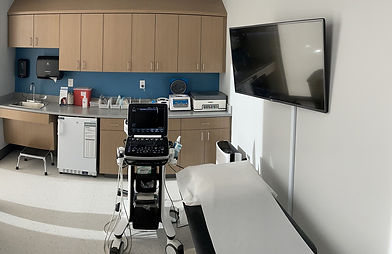
Diagnostic musculoskeletal ultrasound — in the office, same visit: visualizes the proximal hamstring attachment, identifies degenerative changes, thickening, and tears, and rules out complete avulsion
-
MRI when indicated — the best look at the extent of tendinopathy and for distinguishing partial from complete tears; we order it selectively
One critical distinction the imaging must make: partial tendinopathy versus complete avulsion. A fully torn proximal hamstring tendon that has retracted is a surgical problem, and timing matters — those referrals go out urgently, not after months of failed rehab.
Treatment: What Actually Works
The foundation. High hamstring tendinopathy is a load-capacity problem: the tendon's capacity has dropped below what daily life demands. Treatment rebuilds capacity:
-
Isometric loading early (reduces pain and starts rebuilding tolerance)
-
Progressive eccentric and heavy slow resistance work as pain allows
-
Sitting modification — cushions, standing breaks, avoiding the hard-surface compression that aggravates the attachment
-
Running gait and training-error correction — overstriding and sudden mileage jumps are the usual culprits
This phase takes weeks, not days. Tendons remodel slowly, and rushing it is how people end up chronic.
For cases that stall with rehab alone, extracorporeal shockwave therapy is a strong second-line option. It delivers acoustic pulses to the degenerative tendon, stimulating the healing response — and the proximal hamstring is one of the tendons with reasonable published support for shockwave. Non-invasive, no injection, typically a series of sessions.
ases
When high hamstring tendinopathy persists despite quality rehab — or when the patient needs a faster, more definitive intervention — ultrasound-guided PRP injection into the proximal hamstring attachment is our primary interventional treatment.
What the evidence shows: published case series and small studies of PRP for chronic proximal hamstring tendinopathy report meaningful pain reduction and return-to-sport rates in patients who had failed conservative care. The evidence base is smaller than for, say, tennis elbow — we'll tell you that directly — but the pattern is consistent: patients who haven't responded to months of rehab often improve after PRP.
What PRP does here: the concentrated platelets are placed precisely at the degenerative attachment under ultrasound guidance, delivering growth factors into tissue whose own healing response has stalled. We use a high-dose, double-spin preparation — not a generic kit — because the limited data that exists favors adequate dosing.
What PRP doesn't do: it doesn't regrow normal tendon on demand, and it doesn't replace the rehab phase. The patients who do best are the ones who combine the injection with the loading program — the PRP restarts healing, the rehab shapes the result.
For selected patients — particularly those with associated ligamentous laxity around the pelvis contributing to the problem — dextrose prolotherapy is an option. The direct evidence for prolotherapy in hamstring tendinopathy specifically is thin, and we'll say so during your evaluation rather than bundle it into every plan.
-
Repeated cortisone injections near the hamstring attachment. Steroids can weaken tendon tissue, and the sciatic nerve runs immediately adjacent to the proximal hamstring — precision matters enormously here, which is another reason every injection we do is ultrasound-guided.
-
Surgery for tendinopathy. Debridement of the hamstring attachment is occasionally discussed for truly recalcitrant cases, but it's a last resort after all nonsurgical options — including PRP — have been exhausted.
Recovery Timeline
Tendons are slow. A realistic trajectory:
-
Weeks 1–4: Pain with sitting begins to ease; rehab progresses from isometrics to loaded exercises
-
Weeks 6–12: Return to easy running for most; PRP patients typically turn the corner in this window
-
3–6 months: Full return to prior training loads for chronic cases
If you've had this for a year, it won't resolve in two weeks — but it should be clearly trending better within the first month of the right program. If it's not, we reassess the diagnosis rather than repeat a failing plan.
When to Get Evaluated
-
Buttock/sit-bone pain lasting more than 6 weeks despite rest
-
Pain that worsens with sitting and running
-
A "sciatica" diagnosis that never quite fit, with a normal spine workup
-
Urgently: sudden severe buttock/thigh pain with weakness or a palpable defect after a sprint or fall — possible complete avulsion, which is time-sensitive
Schedule Your Evaluation
Call Carolina Nonsurgical Orthopedics at 919.719.2270 or schedule your visit online. With offices in Raleigh and Cary, NC — and in-office ultrasound for same-day diagnosis — we'll determine whether your buttock pain is hamstring tendinopathy or one of its mimics, and build a plan around fixing it.
Frequently Asked Questions
Is high hamstring tendinopathy the same as a pulled hamstring?
No. A pulled hamstring is an acute muscle tear with a sudden onset — you feel it pop during a sprint. Tendinopathy is gradual degeneration at the tendon attachment, with deep aching that builds over weeks to months. They can coexist, but the treatments differ.
Will I need surgery?
Almost certainly not for tendinopathy itself. Surgery enters the conversation only for complete proximal hamstring avulsions (fully torn and retracted) — a different injury that we identify on imaging and refer urgently.
How is PRP different from a cortisone shot for this?
Cortisone suppresses inflammation, but this condition isn't primarily inflammatory — it's degenerative. Steroids near the hamstring attachment also carry tendon-weakening risks and the sciatic nerve sits right next door. PRP aims to restart the stalled healing response instead of masking symptoms.
Can I keep running while being treated?
Usually yes, with modification — not complete rest. We typically pull the aggravating loads (hills, sprints, sudden mileage jumps) while maintaining easy running within pain limits. Complete rest deconditions the tendon further; the goal is the right load, not no load.
Why didn't the cortisone shot fix it?
Because cortisone treats inflammation, and chronic hamstring tendinopathy is degeneration with a stalled healing response. Temporary relief followed by return of pain is the classic pattern — it's a diagnostic clue pointing toward tendinopathy rather than away from it.

TREATMENT OPTIONS FOR HAMSTRING TENDONITIS
As with most orthopedic conditions, patients will often begin with a combination of physical therapy, anti-inflammatories, ice and rest (and in some cases, steroid injections). When these methods are no longer effective, Carolina Nonsurgical Orthopedics offers the latest in cutting-edge treatments to reduce pain and get you back to the activities you enjoy. Some of these innovative alternatives to surgery include Orthobiologics and Regenerative Medicine treatments, such as:
-
Platelet-Rich Plasma (PRP) Injections: Use your own platelets to reduce inflammation and accelerate healing.
-
Prolotherapy: Uses dextrose (sugar water) in place of steroid to reduce pain and promote healing.
-
Shockwave: A non-invasive therapy that uses impulses to treat chronic pain and repair tissue.
-
Ultrasound-Guided Tendon Fenestration: Using the ultrasound, we can target the tendon and use a needle to stimulate healing by creating micro-damage to the tendon.
See the full list of conditions and treatments offered at Carolina Nonsurgical Orthopedics.


WHY CAROLINA
NONSURGICAL ORTHOPEDICS
-
All Providers are BOARD CERTIFIED and Specially Trained in Nonsurgical Orthopedics
-
Over 50,000+ and Counting Procedures Performed
-
Procedures Performed with Ultrasound Guidance for Accuracy and Safety
-
Local and Independent Practice That is NOT a Franchise
-
Discounts for Service Members, Teachers, and Public Servants
-
Serving Raleigh Since 2013