
)_edited_pn.png)


NON-SURGICAL Shoulder Bursitis & Impingement Treatment in Raleigh & Cary, NC
The Shoulder Diagnosis That Means Three Different Things
"Shoulder impingement." "Subacromial bursitis." "Rotator cuff tendinitis." If you've been given one of these labels — or all three by different doctors — you're experiencing one of medicine's messiest diagnostic overlaps. These terms are often used interchangeably, sometimes incorrectly, and the treatment you get depends heavily on which label stuck.
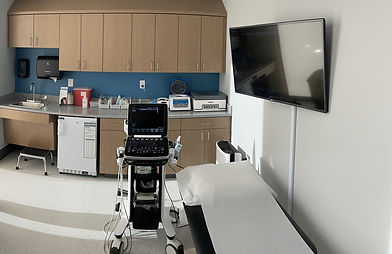
Here's the practical truth: in most cases, these labels describe the same clinical problem — pain from the rotator cuff tendons and the bursa getting pinched under the acromion — and the treatment is overwhelmingly nonsurgical. At Carolina Nonsurgical Orthopedics in Raleigh and Cary, NC, we sort out what's actually generating your shoulder pain with in-office ultrasound, then treat it with a structured program built around rehabilitation and precisely guided injections.
What Are Shoulder Bursitis and Impingement?
The anatomy in 30 seconds: The rotator cuff tendons pass through a narrow space beneath the acromion (the bony roof of the shoulder). Between the tendons and the bone sits the subacromial bursa, a fluid-filled sac that reduces friction. "Impingement" describes these structures getting compressed in that space during arm elevation. "Bursitis" means the bursa itself is inflamed and swollen.
Why the labels blur: In practice, impingement and bursitis almost always coexist with some degree of rotator cuff tendinopathy. The bursa gets irritated because the mechanics are off; the mechanics are off because the cuff is weak or the tendon is degenerative. Treating "the bursitis" while ignoring the cuff dysfunction is why symptoms keep returning. We evaluate and treat the whole mechanism, not just the inflamed sac.
Symptoms
-
Pain with overhead reaching — the hallmark; putting on a jacket, reaching a high shelf
-
The painful arc — pain between roughly 60° and 120° of arm elevation, easing above that
-
Night pain, especially lying on the affected side — often the symptom that finally drives people in
-
Aching at rest after activity, sometimes radiating partway down the arm
-
Weakness with lifting, though usually pain-limited rather than true weakness
-
Symptoms that worsen with repetitive overhead work, swimming, tennis, or painting
What Causes It?
-
Rotator cuff weakness and imbalance — the most common driver; weak cuff and scapular stabilizers let the humeral head ride upward, narrowing the space
-
Overuse — repetitive overhead activity (occupational or athletic)
-
Posture — rounded shoulders and forward head narrow the subacromial space
-
Bone spurs — acromial spurring can contribute, though spurs are common in pain-free shoulders too
-
Prior injury — a fall or strain that started the cycle
How We Diagnose It
Shoulder pain has several look-alikes — AC joint arthritis, biceps tendinopathy, frozen shoulder in its early painful phase, and cervical radiculopathy can all mimic impingement. Our evaluation:
-
History and exam — painful arc testing, impingement signs (Neer, Hawkins-Kennedy), rotator cuff strength testing, AC joint and biceps assessment, neck screen
-
X-ray — evaluates acromial shape, spurring, AC joint arthritis, and calcific deposits; in-office, same visit
-
Diagnostic musculoskeletal ultrasound — visualizes the bursa (is it actually swollen?), the rotator cuff tendons (tendinopathy? partial tear?), and dynamic impingement in real time as you raise your arm
-
MRI when indicated — for suspected significant cuff tears or when the diagnosis remains unclear after exam and ultrasound
The ultrasound matters because "bursitis" is overdiagnosed clinically — many painful shoulders labeled bursitis have a normal bursa and a degenerative cuff tendon instead. The treatment differs.
Why Surgery Usually Isn't the Answer
The traditional surgical fix — subacromial decompression (shaving bone and removing the bursa arthroscopically) — has a problem: in sham-controlled trials, decompression performed no better than placebo surgery. The operation removes the inflamed tissue but doesn't fix the cuff weakness and mechanics that created the impingement in the first place.
Surgery still has a role for specific structural problems — large rotator cuff tears, for example — but for the impingement/bursitis pattern itself, the evidence points firmly toward nonsurgical care. When a surgeon tells you "it's not bad enough for surgery," that's not a dead end — it's the correct call, and it's where our work begins.
Our Nonsurgical Treatment Approach
This is the highest-evidence intervention for impingement, and it's not close. The program targets the actual mechanism:
-
Rotator cuff strengthening — restoring the cuff's ability to center the humeral head
-
Scapular stabilizer training — the shoulder blade is the cuff's platform; a dyskinetic scapula guarantees impingement
-
Posture and movement retraining — thoracic extension, addressing the rounded-shoulder pattern
-
Graded return to overhead activity — not avoidance forever, but progressive reloading
Most patients improve substantially with 8–12 weeks of the right rehab. The wrong rehab — generic bands, no progression, no scapular work — is why many arrive believing "PT didn't work."
Temporary, targeted, not permanent: adjusting the overhead loads and sleeping positions that keep the bursa irritated while rehab rebuilds the mechanics. We modify, we don't immobilize — frozen shoulder is what happens when painful shoulders stop moving entirely.
When pain blocks rehab participation, a precisely placed injection breaks the cycle:
-
Corticosteroid into the subacromial bursa — effective short-term anti-inflammatory for a genuinely swollen bursa; we use it sparingly and never as a repeating strategy, since steroids don't fix mechanics and can weaken tendon tissue
-
PRP — for the cuff tendinopathy component that usually underlies the impingement; small studies support PRP for rotator cuff tendinopathy, and we use ultrasound guidance to place it in the tendon, not just the bursa
-
Prolotherapy — selective use for associated ligamentous contributors; thin direct evidence for impingement itself, offered only when the exam supports it
Every injection is ultrasound-guided. The subacromial space is small and the targets are specific — blind injections miss often enough that guidance isn't optional in our practice.
For calcific tendinopathy of the rotator cuff — calcium deposits visible on X-ray or ultrasound, a distinct and exquisitely painful variant — shockwave therapy has some of the best evidence in all of orthopedics for breaking up deposits and relieving pain. If your "bursitis" is actually calcific tendinopathy, this changes the plan significantly, which is another reason the imaging workup comes first.
What to Expect
Most impingement/bursitis patients improve markedly with 8–12 weeks of structured rehab, with injections used as needed to keep the process moving. Night pain usually resolves first — often the earliest sign the program is working. If progress stalls, we reassess: repeat imaging, reconsider the diagnosis (is there a partial cuff tear? AC joint arthritis driving it?), and refer to a surgeon only when a structural problem declares itself.
When to Get Evaluated
-
Shoulder pain with overhead activity lasting more than 6 weeks
-
Night pain or inability to sleep on the affected side
-
A "bursitis" diagnosis treated with repeated cortisone shots that keeps returning
-
Weakness with lifting, or a traumatic onset (fall, lift) — possible cuff tear
Schedule Your Evaluation
Call Carolina Nonsurgical Orthopedics at 919.719.2270 or schedule your visit online. With offices in Raleigh and Cary, NC — and in-office X-ray and ultrasound for same-day answers — we'll determine what's actually driving your shoulder pain and build a plan around fixing the mechanism, not just quieting the bursa.
Frequently Asked Questions
Is impingement the same as bursitis?
They're usually two descriptions of one problem. Impingement is the mechanical process (structures getting pinched); bursitis is the inflamed bursa that results. In practice they coexist with rotator cuff tendinopathy, which is why treating only "the bursitis" often fails.
Do I need surgery for a bone spur?
Usually not. Acromial spurs are common in people with no shoulder pain at all — they're often incidental findings rather than the cause. The decision for surgery rests on the whole clinical picture, not the spur on the X-ray.
Why do cortisone shots keep wearing off?
Because cortisone treats the inflammation, not the mechanics. The bursa calms down, then the same weak cuff and movement pattern re-irritate it. Shots have a role in breaking the pain cycle so rehab can proceed — they're a bridge, not a destination.
Will this turn into a rotator cuff tear?
Chronic impingement with ongoing cuff degeneration can progress to tearing over time, which is a real argument for treating the mechanics now rather than managing flare-ups indefinitely. That said, most impingement never becomes a full tear — another reason not to rush toward surgery.

TREATMENT OPTIONS FOR BURSITIS AND IMPINGEMENT
As with most orthopedic conditions, patients will often begin with a combination of physical therapy, anti-inflammatories, ice and rest (and in some cases, steroid injections). When these methods are no longer effective, Carolina Nonsurgical Orthopedics offers the latest in cutting-edge treatments to reduce pain and get you back to the activities you enjoy. Some of these innovative alternatives to surgery include Orthobiologics and Regenerative Medicine treatments, such as:
-
Platelet-Rich Plasma (PRP) Injections: Use your own platelets to reduce inflammation and accelerate healing.
-
Stem Cell Injections: Use your own adipose (fat) cells to stimulate regrowth of damaged tissue (primarily beneficial for arthritis and major injuries).
-
Prolotherapy: Uses dextrose (sugar water) in place of steroid to reduce pain and promote healing.
-
Shockwave: A non-invasive therapy that uses impulses to treat chronic pain and repair tissue.
See the full list of conditions and treatments offered at Carolina Nonsurgical Orthopedics.
READ MORE ABOUT ROTATOR CUFF TEARS
The rotator cuff is the group of tendons in the shoulder joint providing support and enabling wider range of motion. Major injury to these tendons may result in the tearing of these tendons, known as a rotator cuff tear. It is one of the most common causes of shoulder pain in middle aged adults and older individuals. Diagnosis of a rotator cuff tear is based on physical examination, X-rays, and imaging studies, such as an MRI (rotator cuff tears are best viewed on magnetic resonance imaging). A rotator cuff tear may cause shoulder pain, tenderness, reduced range of motion, and other potentially disabling symptoms. When seeking to resolve their rotator cuff symptoms, many patients wonder: “Is there a treatment for torn rotator cuff without surgery?” Indeed, there are several nonsurgical treatment options which can help alleviate symptoms. Generally speaking, nonsurgical options are usually prescribed first for partial rotator cuff tears, with surgery being a last-resort option in most cases. Full thickness rotator cuff tears in the active patient will usually require surgery to heal the rotator cuff back to bone.


WHY CAROLINA
NONSURGICAL ORTHOPEDICS
-
All Providers are BOARD CERTIFIED and Specially Trained in Nonsurgical Orthopedics
-
Over 50,000+ and Counting Procedures Performed
-
Procedures Performed with Ultrasound Guidance for Accuracy and Safety
-
Local and Independent Practice That is NOT a Franchise
-
Discounts for Service Members, Teachers, and Public Servants
-
Serving Raleigh Since 2013