.png)
)_edited_pn.png)


Pain vs. Muscle Soreness: How to Tell the Difference
Updated: 15 hours ago
You pushed a little harder than usual yesterday — a longer run, a heavier leg day, your first pickleball game of the season — and this morning your body is letting you know about it. Now comes the question every active person asks: is this just soreness, or did I actually hurt something?
Getting the answer right matters: soreness is a normal part of getting stronger, while an injury needs a different approach — and guessing wrong can turn a minor problem into a months-long ordeal. Here's how to tell the difference, the warning signs that mean stop and get checked, and when persistent pain deserves an orthopedic evaluation at our Raleigh and Cary offices.
What Is Muscle Soreness (DOMS)?
Delayed-onset muscle soreness — DOMS — is the achy, stiff feeling that shows up after unfamiliar or intense activity. It's not lactic acid (that clears within an hour). It comes from microscopic damage to muscle fibers, particularly after eccentric movements — the lengthening-under-load parts of exercise like the lowering phase of a squat or downhill running.
DOMS has a signature pattern that makes it recognizable:
Onset is delayed. Soreness doesn't peak during or immediately after the workout. It typically builds over 12–24 hours, hits its worst around 24–72 hours, and fades within three to five days.
It's diffuse and symmetric. DOMS spreads broadly across the muscles you worked — if you trained both sides, both sides hurt. Sore quads after leg day means all of both quads, not one sharp spot on one leg.
It's dull and achy, not sharp. Soreness feels like a heavy, tender stiffness. It doesn't throb, stab, or shoot anywhere.
It improves with gentle movement. One of the most reliable clues: a sore muscle loosens up and feels noticeably better once you warm up — a walk or light mobility work takes the edge off, even if it returns later when you sit still.
It doesn't swell. DOMS doesn't cause visible joint swelling, bruising, or heat.
DOMS is a sign your muscles were challenged — and in most cases it's harmless. Regular training reduces its severity; your body adapts. The first hard workout of a new program is always the worst.
What Does Injury Pain Feel Like?
Injury pain behaves differently from soreness in almost every way. Where DOMS is delayed, diffuse, dull, and bilateral, injury pain tends to be sudden, sharp, localized, and one-sided.
The timing is wrong for soreness. The most telling sign is often when the pain started. Pain that arrives mid-workout or mid-game — a sudden sharp pull, a pop you felt or heard, a bad landing — is not DOMS. DOMS never shows up during the activity that caused it.
It's localized. An injury usually has a "spot." You can point to it with one finger. Soreness can't be pinpointed; it covers whole muscle groups.
It's one-sided. If one knee hurts sharply while the other feels fine, that's an injury pattern — not soreness.
It worsens with use. DOMS loosens up with gentle movement; injury pain does the opposite — the more you load it, the worse it gets, and it never "warms up" out of it.
It comes with swelling, bruising, or deformity. A swollen joint, a new bruise, a clicking or catching sensation, or any visible change in a muscle or joint's shape points to tissue damage — not soreness.
It alters how you move. Limping to protect one side, being unable to bear full weight, or finding you can't do something that was easy last week are all injury signals.
Red Flags: Stop and Get Evaluated
Some symptoms mean you shouldn't wait to find out what's going on. If any of the following apply, skip the "is it soreness?" debate and get an orthopedic evaluation:
Pain at rest or at night. Pain that throbs while you're on the couch or wakes you from sleep is a red flag.
Significant swelling. A joint that is visibly puffy, hot, or misshapen isn't just sore.
A pop, snap, or tearing sensation at the moment of injury. Sudden mechanical events often mean a ligament, tendon, or muscle gave way.
Numbness, tingling, or weakness. These suggest nerve involvement — a different category of problem entirely.
Can't bear weight or use the limb normally. If you can't walk without a limp, lift what you normally lift, or move the joint through its usual range, get it checked.
Pain that doesn't improve after 1–2 weeks. Even minor injuries should trend better within a couple of weeks. Pain that stays flat — or worsens — deserves a diagnosis.
Deformity or a feeling of instability. A joint that looks wrong, buckles, or feels like it might give way needs prompt evaluation.
These aren't reasons to panic — many turn out to be manageable strains or tendinopathy. But they are reasons not to guess: an accurate diagnosis at the start almost always shortens recovery.
How to Return to Activity Safely
If your symptoms fit the soreness pattern — dull, diffuse, improving with movement, no swelling — you don't need to shut everything down. The approach is relative rest and gradual reload:
Keep moving gently. Light activity on sore days beats total rest — walking, easy cycling, or mobility work increases blood flow and usually makes soreness feel significantly better.
Don't test it with intensity. Soreness is fine at low intensity, but not a green light for another hard session — heavy training on deeply sore muscles changes your mechanics and raises injury risk.
Respect the 10% rule for comebacks. If you've been sidelined, don't jump back to your pre-injury volume. Gradual progression — roughly 10% increases per week — is the safest way to reload tissue.
Sleep and protein matter. Muscles rebuild during sleep, and adequate protein supports repair — the basics make a real difference in bounce-back time.
Heat, hydration, and patience. Warm showers, gentle stretching, and staying hydrated help you feel better, but nothing replaces time. DOMS runs its course in a few days.
When Persistent Pain Deserves an Orthopedic Evaluation
Here's the scenario we see most often: the soreness that never went away. The quad ache still there at week six. The shoulder that "warmed up" during workouts now aching at rest. The knee that was fine on the flat now complaining on stairs. At this point, you're not dealing with soreness — you're dealing with an unresolved injury or an overuse tendinopathy.
This is where an accurate diagnosis changes everything. In-office ultrasound imaging lets us see what's going on — tendon thickening, partial tears, bursitis, joint effusion — right in the office, at exactly the spot you point to. No guesswork, no waiting weeks for imaging authorization.
And for stubborn tendinopathy that hasn't responded to rest and rehab — Achilles, patellar, rotator cuff, tennis elbow — regenerative options exist well before surgery enters the conversation. High-dose PRP, for example, can help restart the healing process in tendons that have stalled; see our PRP page for details. Surgery remains a last resort for these problems, not a next step.
Frequently Asked Questions
How long should muscle soreness last? Typical DOMS peaks at 24–72 hours and resolves within three to five days — occasionally a week after a truly novel workout. Soreness that's unchanged or worsening after seven to ten days, especially localized to one spot, is no longer typical DOMS and deserves attention.
Is it okay to exercise when I'm sore? Yes, at low intensity. Gentle movement usually makes DOMS feel better and doesn't delay recovery. Just avoid another hard session targeting the same muscles — that raises injury risk. Train a different muscle group or take an active-recovery day.
What's the difference between soreness and a pulled muscle? A pulled (strained) muscle has a specific moment of onset — a sudden sharp or tearing feeling during activity — and a pinpoint location that worsens when you load it. Soreness is delayed, diffuse, dull, and improves with gentle movement. If you remember the exact rep or step where it happened, it's almost certainly a strain, not soreness.
Should I ice or heat sore muscles? Either can provide comfort, but neither fixes the underlying process — time does. Ice tends to feel better for acute injuries with swelling; heat or warm showers tend to feel better for plain muscle soreness. For an actual injury, get a diagnosis before deciding on a treatment approach.
I keep getting sore in the same spot every time I work out. What does that mean? True DOMS moves around based on what you trained. Pain that always returns to the exact same spot — especially if sharp, one-sided, or joint-related — suggests an underlying issue like tendinopathy rather than normal soreness.
Take the Next Step
Soreness is a normal part of an active life. Persistent, localized, or worsening pain is not — and you don't have to guess which one you're dealing with. An accurate ultrasound diagnosis can tell you exactly what's going on and map out the right nonsurgical plan.
Call Carolina Nonsurgical Orthopedics at 919.719.2270 or schedule your visit online. With offices in Raleigh and Cary, NC, we're here to help you stay active and tell soreness from injury — without surgery whenever possible.
About Your Physicians
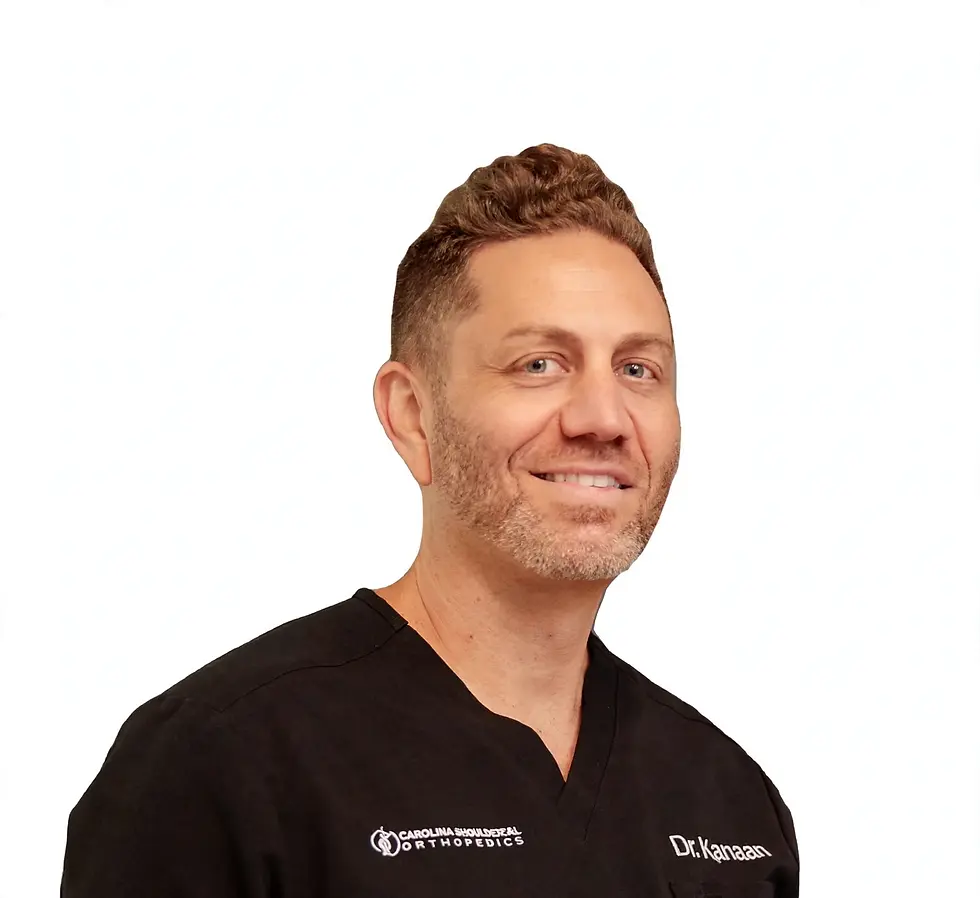
Dr. Matthew Kanaan
Nonsurgical Orthopedic Specialist
Founder of Carolina Nonsurgical Orthopedics. Fellowship trained in sports medicine at Duke; residency in family medicine at Duke, where he served as Chief Resident.

Dr. Pierce Knox
Nonsurgical Orthopedic Specialist
Fellowship trained in nonsurgical sports medicine at Penn Medicine; residency in primary care at Christiana Care.