.png)
)_edited_pn.png)


Torn Meniscus Recovery Time: What to Expect and What Affects It
"How Long Until I'm Better?" — The Honest Timelines
Recovery from a meniscus tear depends entirely on which treatment path you're on. Here are the real numbers, not the optimistic ones.
Rehab Without Surgery: 6–12 Weeks
For degenerative tears and stable traumatic tears without mechanical symptoms, structured physical therapy is first-line — and the evidence supports it. Expect:
Weeks 1–3: Pain and swelling settle; range of motion returns
Weeks 4–8: Progressive strengthening; most daily activities normalize
Weeks 8–12: Return to sport for most non-pivoting activities
The key variable is mechanical symptoms. A tear that catches or locks doesn't rehab well — that's a mechanical problem needing a mechanical solution.
PRP for Meniscus-Related Pain: 6–12 Weeks to Meaningful Improvement
PRP doesn't stitch a torn meniscus back together — no injection does. What it treats is the degenerative, inflammatory environment around the tear: the synovitis, the early arthritis, the tissue irritation generating the pain. Improvement builds gradually over 6–12 weeks. Best candidates: degenerative tears with arthritic pain components, not displaced bucket-handles.
Meniscectomy (Trimming): 4–6 Weeks to Daily Activity
Arthroscopic partial meniscectomy has the fastest felt recovery — many patients walk comfortably within days. But the honest context: for degenerative tears, sham-controlled trials show it works no better than placebo at one to two years. Fast recovery from a surgery that didn't need to happen isn't a win. For traumatic tears with mechanical symptoms in younger knees, it's a different story — genuinely indicated, genuinely effective.
Meniscus Repair (Stitching): 4–6 Months
True repair — suturing the tear rather than removing it — has the longest recovery and the best long-term joint preservation. Restricted weight-bearing for weeks, no pivoting for months, return to sport around 6 months. Worth it when the tear pattern allows: a repaired meniscus protects the knee; a removed one accelerates arthritis.
What Speeds Recovery (Any Path)
Quadriceps strength — the single biggest modifiable factor. Pre-hab strength predicts post-treatment outcomes across every pathway.
Swelling control — persistent effusion inhibits quad activation (arthrogenic muscle inhibition). A swollen knee can't rehab.
Appropriate loading — too much too soon re-tears repairs; too little for too long weakens everything. The dosing matters as much as the exercise.
What Slows It Down
Smoking and poor metabolic health (tendon and cartilage healing are measurably worse)
Returning to pivoting sports before clearance
Treating a mechanical problem (locking bucket-handle) with a biologic solution, or vice versa — wrong-path treatment wastes months
Get the Right Path From the Start
The biggest determinant of recovery time isn't the tear — it's whether the first treatment matched the actual problem. Call Carolina Nonsurgical Orthopedics at 919.719.2270 or schedule online. Offices in Raleigh and Cary, NC. We'll read the MRI in context, test the knee, and put you on the timeline that fits — not the one that fits a protocol.
About Your Physicians
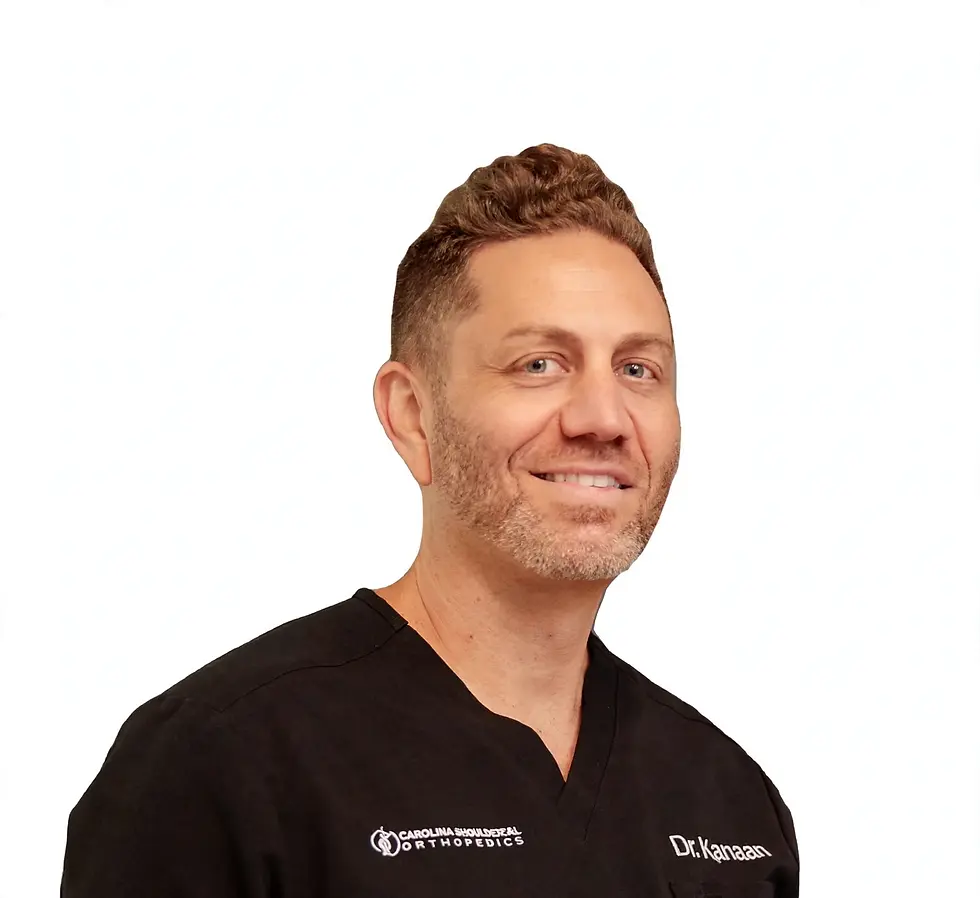
Dr. Matthew Kanaan
Nonsurgical Orthopedic Specialist
Founder of Carolina Nonsurgical Orthopedics. Fellowship trained in sports medicine at Duke; residency in family medicine at Duke, where he served as Chief Resident.

Dr. Pierce Knox
Nonsurgical Orthopedic Specialist
Fellowship trained in nonsurgical sports medicine at Penn Medicine; residency in primary care at Christiana Care.