


De Quervain's Tenosynovitis (Mommy's Thumb): Why Lifting Your Baby Hurts Your Wrist
Updated: Oct 14
Quick answer: What it isn't: thumb CMC (basal joint) arthritis causes pain at the thumb base too, but with grinding on axial rotation and usually in an older population — the grind test sorts them out. It's one of the most straightforward diagnoses in hand medicine — and one of the most gratifying to treat, because the right intervention usually works fast.
The New-Parent Wrist
A few weeks after the baby arrives, a new pain shows up: sharp, stabbing pain on the thumb side of the wrist every time you lift the baby, wring out a washcloth, turn a doorknob, or scroll your phone one-handed at 3 a.m. It's so common it has a nickname — mommy's thumb — though dads, grandparents, and anyone doing repetitive thumb-and-wrist work get it too.
The formal name is De Quervain's tenosynovitis: irritation and thickening where two thumb tendons pass through a tight tunnel at the wrist. It's one of the most straightforward diagnoses in hand medicine — and one of the most gratifying to treat, because the right intervention usually works fast.
The Anatomy in 30 Seconds
On the thumb side of your wrist sits the first dorsal compartment — a fibro-osseous tunnel carrying two tendons: the abductor pollicis longus (APL) and extensor pollicis brevis (EPB), which move the thumb outward and extend it. In De Quervain's, the tunnel's roof (the extensor retinaculum) thickens and the tendons swell, so they stop gliding smoothly. Every thumb motion becomes a tug-of-war through a too-tight sheath. That's the pain.
Why New Parents Get It
Lifting an infant is a perfect storm for this anatomy: the baby's weight hangs on a wrist that's bent with the thumb splayed and extended — exactly the position that loads the first dorsal compartment. Add hormonal fluid shifts (pregnancy and breastfeeding-related edema make tight tunnels tighter), sleep deprivation (lower pain tolerance, worse tissue recovery), and thousands of repetitions daily, and you have the highest-risk population in the clinic. It's not "just" overuse; the fluid dynamics genuinely predispose.
Other classic setups: racquet sports, golf, rowing, gaming and phone overuse, childcare and nursing work, and any job with repetitive wrist-thumb motion (assembly, packaging, hairstyling).
How It Feels — and the Test That Clinches It
Sharp pain over the radial (thumb) side of the wrist, at the base of the thumb
Pain with lifting, gripping, pinching, wringing, or lifting the thumb against resistance
Tenderness and sometimes visible swelling right over the first dorsal compartment
Pain that can radiate up the forearm along the thumb side
A creaking sensation with thumb movement in more established cases
The Finkelstein test: make a fist with your thumb tucked inside your fingers, then bend the wrist toward the pinky side. Sharp pain over the radial wrist is positive. (Clinicians sometimes use the Eichhoff maneuver, a close variant — same idea.) It's a bedside test, takes five seconds, and when combined with the story is usually diagnostic on its own.
What it isn't: thumb CMC (basal joint) arthritis causes pain at the thumb base too, but with grinding on axial rotation and usually in an older population — the grind test sorts them out. Scaphoid problems hurt more with wrist extension and loading. Intersection syndrome hurts a few inches up the forearm where the tendons cross. Sorting these takes an exam, not a guess.
How We Confirm It
History and exam — including Finkelstein — establish the diagnosis in most cases.
Diagnostic ultrasound, performed in-office, is excellent here: it shows the thickened retinaculum, tendon swelling, and any fluid around the tendons in real time, and confirms the diagnosis when the exam is equivocal. It also guides injections with precision — important in this crowded anatomical neighborhood, where the superficial radial nerve runs close by.
X-ray is occasionally useful to rule out arthritis or old fracture, but the tendons themselves don't show on X-ray.
Nonsurgical Treatment That Works
Activity modification — done right. The highest-yield change for new parents is lifting mechanics: scoop the baby with palms up and wrists straight instead of pinching under the arms with thumbs splayed. Keep wrists neutral during feeds, use a nursing pillow to bring the baby to you rather than hunching to the baby, and alternate hands for phone scrolling. Small changes, big difference in daily tendon load.
Thumb spica splinting. Immobilizing the thumb and wrist for 2–4 weeks (a removable splint, worn especially during aggravating activities and sleep) calms many mild cases. It's unglamorous and effective — particularly when combined with the lifting changes above.
NSAIDs and ice. Reasonable first-line adjuncts for pain and swelling in the early weeks.
Corticosteroid injection — the workhorse. A single ultrasound-guided corticosteroid injection into the tendon sheath resolves De Quervain's in the majority of patients, often durably. It's the best-evidenced intervention for this condition by a wide margin, and ultrasound guidance matters: the first dorsal compartment sometimes has a septum dividing it, and missing one sub-compartment is the classic reason a blind injection "didn't work." One to two injections cure most cases; we don't do endless series.
**PRP for refractory cases.** When quality conservative care plus one or two well-placed steroid injections haven't resolved it — or when a patient wants to avoid steroids — ultrasound-guided PRP is a reasonable next step. Honest framing: the evidence is early, limited to small studies and case series in tenosynovitis. It's an option, not a proven upgrade over steroid.
Shockwave therapy. There's modest supportive evidence for shockwave in De Quervain's as a noninvasive option, and we consider it for patients who prefer to avoid injections entirely or as an adjunct during rehab.
Laser therapy. Low-level laser can help with pain modulation as an adjunct. Supporting role, not the treatment.
Hand therapy. After the acute phase, graded thumb and wrist strengthening plus ergonomic coaching reduces recurrence — especially the lifting retraining for parents.
Surgery — surgical release of the first dorsal compartment — is the backstop for the small minority who fail everything above. It's a short outpatient procedure with high success rates, and knowing when to stop injecting and refer is part of good care. Most patients never need it.
Red Flags and Look-Alikes
Numbness or burning over the back of the thumb — the superficial radial nerve (Wartenberg's syndrome) can be irritated in the same area; steroid placed carelessly can worsen it, another reason for ultrasound guidance
Pain primarily with thumb-base grinding or in older adults — think CMC arthritis, a different treatment path
Wrist pain after a fall — rule out scaphoid fracture before assuming tendonitis
Signs of infection — redness, warmth, fever after any injection or trauma needs prompt evaluation
When to Get Evaluated
Radial wrist pain persisting more than 2–3 weeks despite rest and splinting
Pain that's changing how you lift your baby, work, or play
A previous injection (done elsewhere, possibly blind) that didn't help — a guided repeat often succeeds where it failed
Numbness accompanying the pain, or any doubt about the diagnosis
Schedule Your Evaluation
Call Carolina Nonsurgical Orthopedics at 919.719.2270 or schedule your visit online. With offices in Raleigh and Cary, NC — and in-office X-ray and ultrasound for same-day answers — we'll confirm the diagnosis at the bedside, treat it precisely under ultrasound guidance, and get your wrist back to baby-lifting duty.
About Your Physicians
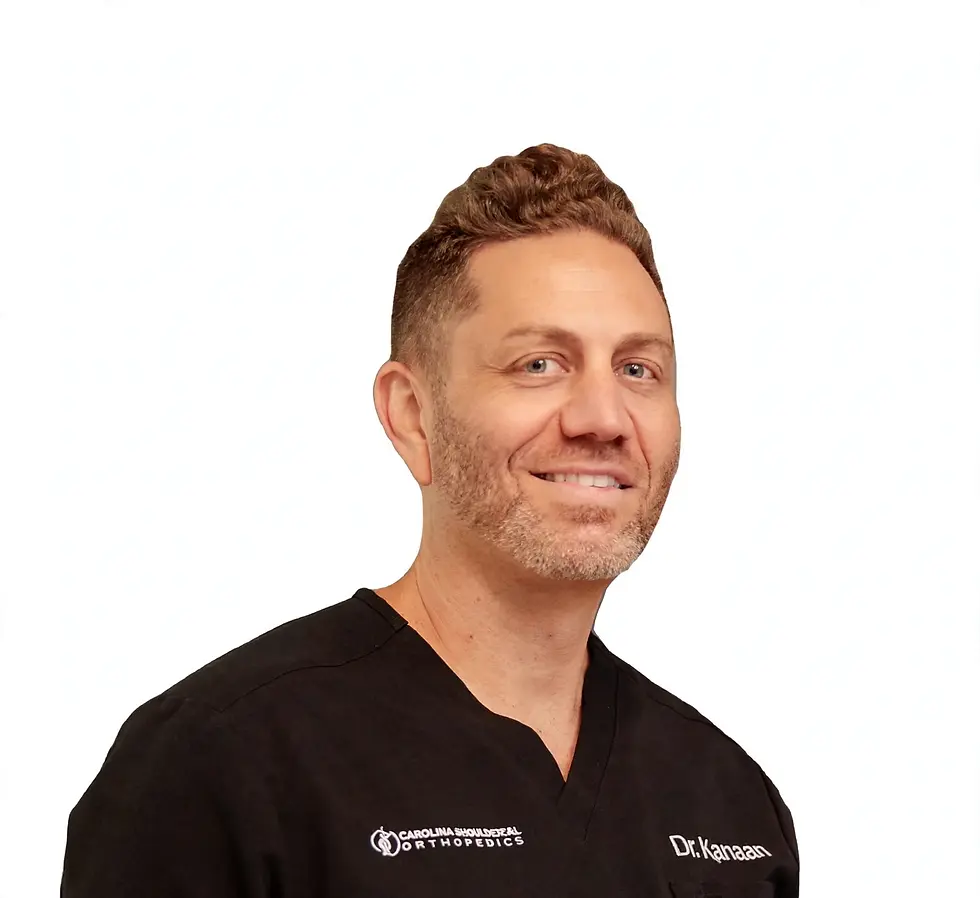
Dr. Matthew Kanaan
Nonsurgical Orthopedic Specialist
Founder of Carolina Nonsurgical Orthopedics. Fellowship trained in sports medicine at Duke; residency in family medicine at Duke, where he served as Chief Resident.

Dr. Pierce Knox
Nonsurgical Orthopedic Specialist
Fellowship trained in nonsurgical sports medicine at Penn Medicine; residency in primary care at Christiana Care.


